
😧🏘 How does the stress of buying a house affect recent home buyers and their home search? 🏘😰
Nearly half of recent home buyers (44%) say they followed their heart more than their head when buying a home, and three-quarters (76%) admit to overlooking or downplaying red flags. Now, two-thirds (66%) have regrets about their purchase.
Recent Buyer Motivations | Logic vs. Emotion in Home Buying | The Impact of Emotional Attachment and FOMO | Why Buyers Are Moving Faster Than Expected | Recent Buyer Regrets
When it comes to buying a home, most advice, guidance, and analysis approach the issue from a purely practical perspective: the cost of the home and how it fits into a buyer’s budget, the interest rate they pay on the mortgage, or the time and cost involved in discovering and fixing issues previous owners left behind.
Although buying a home is undoubtedly a logical and financial decision, it’s also often a psychologically challenging and emotional one for many buyers. Home buyers deal with a variety of mental factors when purchasing a new property, from widely varying motivations to doubts, stress, and regrets during and after the sale.
These factors can be hard to quantify with traditional data, but there’s little doubt they have a massive effect on the housing market and the people participating in it.
To better understand what buyers are thinking and feeling about their recent home purchases, Best Interest Financial and Clever Real Estate surveyed 1,000 Americans who have bought homes between 2023 and 2025, split roughly evenly over the three years. More than 1 in 3 of those surveyed (39%) were buying a home for the first time, including 59% of millennials and 73% of Gen Z.
Nearly half of recent home buyers (44%) say they followed their heart more than their head when buying a home, and three-quarters (76%) admit to overlooking or downplaying red flags.
One-quarter (25%) became emotionally attached in a single showing or less, while over half (52%) were emotionally invested in their home before they even moved in. Troublingly, however, 2 in 3 recent buyers (66%) have regrets about their home purchase.
The survey also revealed the biggest pressures affecting recent buyers, ranging from the economy and the pace of the housing market to peer pressure and fear of missing out.
Read on to learn more about what’s motivating today’s home buyers, their most important factors when shopping for a home, and how a home search can succeed or fail based on the emotions and psychology of those looking.
🤔 Psychology of Buying a Home Statistics
- 45% of recent home buyers admit to having doubts about their buying decisions at some point.
- 41% of recent first-time buyers were embarrassed by their budget during the home-buying process, roughly 2.5x the number of repeat buyers (17%).
- Nearly half of first-timers (44%) say that, at some point, the home-buying process or housing market made them feel like a failure.
- Nearly half of recent home buyers (44%) say they followed their heart more than their head when buying a home.
- However, 41% wish they were more rational and less emotional when buying their home.
- Many recent home buyers quickly became emotionally attached to the homes they ended up buying, with 1 in 4 (25%) saying it happened in one showing or even before seeing the home.
- Three-quarters (76%) admit to overlooking or downplaying red flags in their home purchase, such as necessary repairs to the house (21%) or the price (20%).
- Over a third of recent buyers (36%) say they made an offer on a home they weren’t fully sure about just because they didn’t want to lose it.
- Roughly 1 in 3 recent buyers (34%), including 44% of first-timers, made an offer on a home that was outside their original budget because they liked it so much.
- 42% say they thought buying a home would actually decrease their stress levels. Just 20% say it did, however.
- Two-thirds of all recent home buyers (66%) and three-quarters of first-timers (76%) have regrets about their purchase.
- A third of recent buyers (32%) still find themselves checking new real estate listings, even after purchasing their home.
Almost Half of Recent Home Buyers Followed Their Heart Over Their Head in the Buying Process
For most people, a home will be the largest purchase of their lifetime, one that can dictate both their comfort and financial security for decades to come. In theory, this would suggest buyers take extra care to make the most sensible decision possible.
However, nearly half of recent home buyers (44%) say they followed their heart more than their head when buying their home. Over a third (36%) even believe their emotions caused them to act against their better judgment when buying a home.
Buyers aren’t necessarily happy about this influence on their decision-making: 41% wish they were more rational and less emotional when purchasing.
Regardless of how they actually decided, in hindsight, nearly half of buyers (45%) believe home buying should be a logical process, 3x more than the number who say it should be emotional (14%).
First-time home buyers (25%), however, are more than 3x more likely than repeat buyers (7%) to think buying should be an emotional decision.
In addition, many recent buyers don’t have a very positive view of their fellow buyers and how they came to their decisions. Nearly half of recent home buyers (43%) also believe most people approach home buying emotionally. Only 17% think others are logical when it comes to buying a home.
Agents tend to agree with buyers. Almost three-quarters of agents surveyed by Clever (71%) say emotions play a bigger role than logic for most buyers during the home-buying process.
More Than 1 in 3 Recent Buyers Became Attached to a Home Before Seeing it in Person
Many recent home buyers quickly became emotionally attached to the home they ended up buying, with 1 in 4 (25%) saying it happened in one showing or before seeing it in person.
Over half (52%) say they were emotionally attached before moving in, with another 22% saying their attachment began as soon as they moved in.
First-time home buyers (55%) are slightly more likely than repeat buyers (49%) to say they became attached to their homes before moving in, evidence of the excitement that often comes with owning a home for the first time.
Meanwhile, repeat buyers (13%) were also about twice as likely as first-timers (7%) to say they have never become emotionally attached to their homes, reinforcing the more logical, business-like approach of these seasoned homeowners.
Even more notably, 36% of recent buyers admit they felt emotionally attached to a home before seeing it in person, regardless of whether they later purchased it.
Three-Quarters of Recent Buyers Overlooked or Downplayed Red Flags About Their Homes
With many buyers becoming emotionally invested in their future homes early in the buying process, it’s little surprise that three-quarters (76%) admit to overlooking or downplaying red flags.
Even so, just 42% of recent buyers say they convinced themselves that ignoring red flags was truly “worth it” when buying a home, leaving a 34 percentage point gap that seemed to know their decision to overlook or downplay red flags was a bad idea, even at the time.
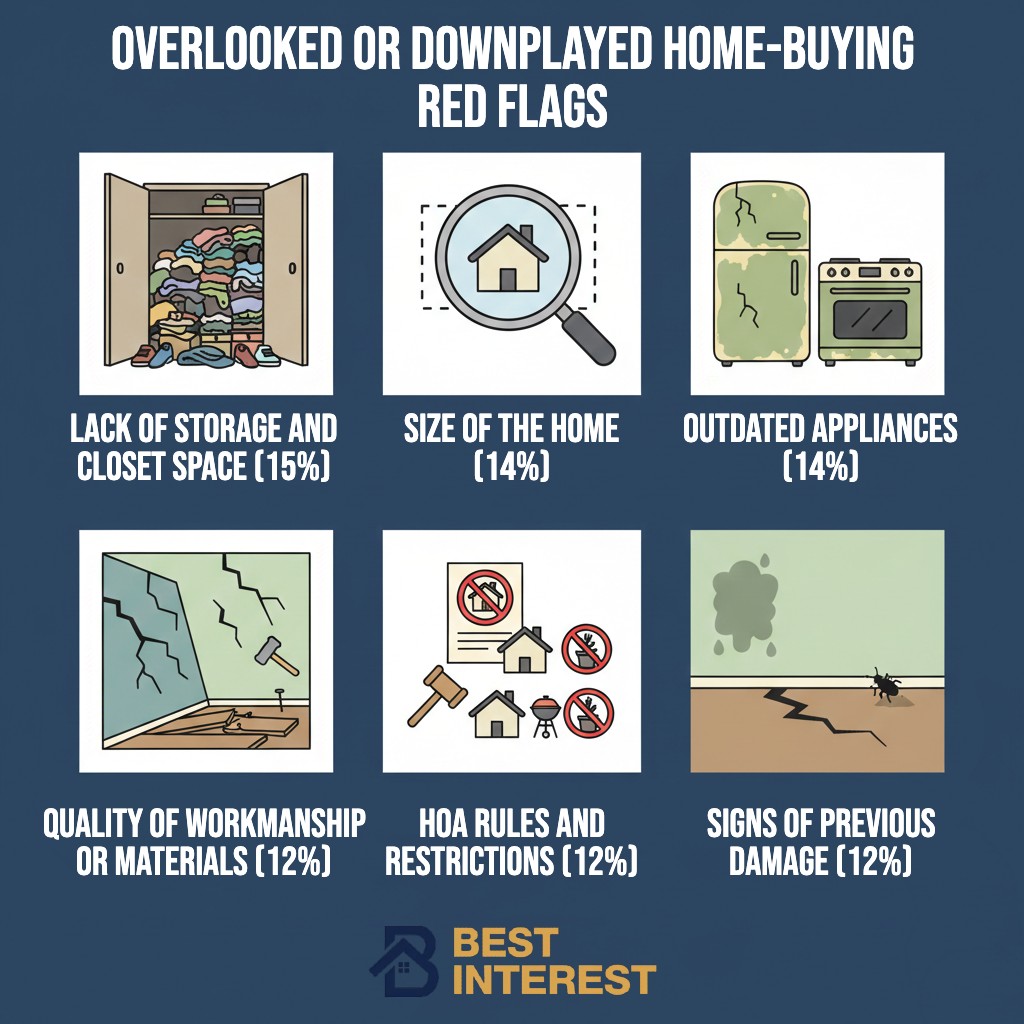
The most common overlooked or downplayed red flags include necessary repairs to the house (21%) and the price (20%).
More than 1 in 8 recent home buyers also say they downplayed the following red flags:
- A lack of storage and closet space (15%)
- The size of the home (14%)
- Outdated appliances (14%)
- The quality of workmanship or materials (12%)
- HOA rules and restrictions (12%)
- Signs of previous damage (e.g., water, pests, foundation) (12%)
First-time home buyers (82%) were more likely to ignore or downplay red flags than repeat ones (73%). The biggest differences in overlooked issues were:
- Price (25% of first-timers vs. 18% of repeat buyers)
- Signs of previous damage (15% of first-timers vs. 9% of repeat buyers)
- Safety or security concerns (10% of first-timers vs. 3% of repeat buyers)
Mixed Emotions, Outside Pressures Motivated Recent Home Buyers
When it comes to what’s motivating recent buyers to jump into the real estate market, there’s no doubt there’s a complicated mix of emotions at play. However, recent home buyers were generally far more likely to say positive emotions and feelings influenced their decision to buy their home than negative emotions.
The most common emotions for home buyers are:
- Excitement (38%)
- Happiness (36%)
- Stability/security (35%)
- Hopefulness (30%)
- Achievement (28%)
- Relief (25%)
Almost half of buyers (49%), however, admit to at least one negative feeling or that influenced their home-buying experience, including:
- Stress (20%)
- Anxiety (17%)
- Exhaustion (12%)
- Uncertainty (12%)
- Frustration (10%)
Overall, 45% revealed mixed emotions as influences in their purchase, selecting both positive and negative responses. The same number (45%) admit to having doubts about their buying decisions at some point.
Three-Quarters Felt Outside Pressures in Home Purchase Decision
Of course, there are more than just buyers’ own feelings and emotions at play. Outside influences and pressure were also a factor for 78% of recent home buyers. However, there were notable differences between first-time and repeat buyers on precisely which pressures they felt.
For example, 1 in 4 repeat home buyers (25%) cited pressure from limited inventory of homes, compared to only 17% of first-timers. Likewise, repeat buyers (22%) were more likely than first-time buyers (15%) to say pressure from a partner or spouse was involved in their purchase.
Meanwhile, first-time buyers (20%) were roughly twice as likely as repeat buyers (11%) to say they wanted to escape an undesirable living situation, such as a bad roommate or living with parents.
Notably, 1 in 8 first-time home buyers (12%) say pressure to "keep up" with peers motivated their home purchase. Just 3% of repeat buyers said the same.
Another crucial outside pressure is seeing friends or family buy homes. About 1 in 4 recent buyers overall (27%) say this encouraged them to purchase a home, but nearly half of first-timers (44%) say this was the case. That’s roughly 3x the number of repeat buyers who felt the same encouragement (16%).
First-Time Home Buyers Experience More Extreme Emotions Than Repeat Ones
Those going through the often momentous and life-changing experience of buying a home for the first time are likely to experience stronger and different emotions than those who have bought before.
As might be expected, first-time buyers (35%) were more likely than repeat buyers (24%) to say the desire for achievement influenced them than repeat buyers (24%). Negative emotions, however, such as stress (25% first-timers, 17% repeat buyers) and anxiety (23% first-timers, 14% repeat buyers), were also more common among first-time home buyers.
Although just 28% of recent buyers overall say they compared themselves negatively to other buyers who seemed to have things easier, this includes 40% of first-time buyers – twice the number of repeat buyers who said the same (20%).
First-time buyers (47%) were also 21 percentage points more likely than repeat ones (26%) to say they felt embarrassed by their stress levels at some point during the home-buying process.
By the same token, 41% of recent first-time buyers were embarrassed about their budget during the home-buying process, roughly 2.5x the number of repeat buyers (17%).
Over half of first-time home buyers (53%) considered their home-buying decisions risky at some point in the process, 21 percentage points higher than repeat buyers (32%). Similarly, roughly half of recent first-time buyers (49%) say they lost control of the home-buying process at some point during the experience, compared to 28% of repeat buyers.
Even more starkly, 44% of first-timers say that, at some point, the home-buying process or housing market made them feel like a failure. Only 21% of repeat buyers went to this extreme.
Still, with roughly 1 in 3 recent home buyers overall (30%) falling into this group, it’s a sign of the difficulty the housing market presents for even seasoned buyers with adequate financial resources.
Emotional Attachment, FOMO Are Major Influences on Home-Buying Strategy
With plenty of strong emotions and a life-changing decision at stake, many home buyers found themselves changing their plans when they found a home they desired.
Among those with an emotional attachment to their home before they closed on it, over three-quarters (82%) admit this attachment influenced their buying strategy.
Over 1 in 5 buyers (21%) say their emotional attachment led them to convince themselves that any risks were worth it because they loved the home, while the same number (21%) say it made them make their strongest possible offer right away.
Meanwhile, a similar proportion acted faster than they wanted to buy their home (20%) or avoided negotiating out of fear of losing the home to someone else (20%).
Fear of missing out can have a profound influence on buying strategy as well. Over a third of recent buyers (36%) say they made an offer on a home they weren’t fully sure about just because they didn’t want to lose it.
This likely happens more often than buyers even realize, as 57% of agents say they’ve seen clients make decisions they later regret due to pressure or fear of missing out.
Nearly 9 in 10 Buyers Say Their Gut Feeling About a Home Was an Important Factor
There’s a lot on the minds of buyers when they begin their home search, ranging from their current needs to their long-term aspirations.
A majority of recent home buyers (56%) say they bought a home that reflects the lifestyle they aspire to, rather than the one they had before buying. Nearly two-thirds (63%) also imagined future moments ranging from family life to holidays while touring homes.
Recent home buyers were nearly unanimous about the five factors that mattered most in their purchase:
- Safety of the area (97%)
- Price relative to the buyer’s budget (97%)
- Location or neighborhood (96%)
- The home’s size (96%)
- Privacy (93%)
Even among these factors, the first three had significantly higher numbers of recent home buyers say they were very important: 76% for safety, 70% for price, and 66% for location. Size and privacy were only very important to 54% and 56%, respectively.
Beyond these obvious factors, a few others stood out in their importance to recent home buyers. These include that the home “felt like them” (92%) and the emotional gut feeling they had about the property (86%).
It’s notable that three-quarters of recent home buyers (75%) also thought the home they bought was “meant to be,” although it’s not clear at what point in the process they came to this conclusion.
Certain factors stand out in their importance to first-time buyers:
- Commute to work (84% of first-time buyers vs. 52% of repeat buyers)
- Feeling the home represented success or accomplishment (79% vs. 54%)
- Pressure from external factors to make the "right" choice (74% vs. 51%)
- Opinions of friends and family (71% vs. 52%)
- Feeling their home is better than others' (54% vs. 29%)
The relative importance of commutes reflects the generational gap between first-time buyers and those who have bought before. Roughly 92% of Gen Z buyers and 87% of millennials say the commute to work from their new house was an important factor, while barely 1 in 4 boomers (28%) say the same.
Younger Buyers Look for Resale Value, Boomers Seek Privacy
Potential resale value is most important to recent Gen Z buyers (91%), 12 points higher than boomers (79%). This tracks with the idea that Gen Zers are still hoping to build wealth through real estate ownership, while boomers and other older buyers enjoy the profits from years of appreciation.
Gen Z (83%) was also almost twice as likely as boomers (42%) to say that pressure from external factors to make the "right" choice was important in their home purchase. Millennials weren’t far behind Gen Z at 73%.
Meanwhile, recent Gen Z home buyers (73%) are 4x more likely and millennials (54%) are 3x more likely than boomer buyers (17%) to say that feeling like their home is better than others’ was important to them.
Overall, Gen Z and millennial home buyers typically rated nearly every factor as more important than older buyers did. The limited exceptions to this trend come in the form of:
- A home’s privacy (important to 95% of boomers and 88% of Gen Z)
- Location (important to 99% of boomers and 92% of Gen Z)
- Safety (important to 99% of boomers and 91% of Gen Z)
Nearly Half of Recent Home Buyers Moved Faster Than Desired, With the Economy a Main Influence
It’s often worthwhile to take your time with any big decision, but the real estate market and economy of the 2020s haven’t afforded all home buyers that luxury. Overall, 42% of recent home buyers say they moved faster than they were comfortable with when buying their home.
A substantial 41% of recent home buyers, including a majority of first-timers (56%), admit they felt pressured to buy sooner than they wanted due to fears the economy could worsen in the near future.
Likewise, 61% of first-time home buyers believe the economy, rather than their personal or emotional readiness, dictated their home-buying timeline. Barely a third of repeat buyers (35%) feel the same.
Whether they know what they want or the primacy effect is at work, 1 in 4 recent home buyers (25%) say they ended up purchasing the first home they toured. This rises to more than 1 in 3 (37%) among first-time buyers.
On the other hand, 41% of recent buyers toured a home they liked more than the one they ended up buying, and over a third (34%) also admit they fell in love with a home they didn’t end up purchasing.
No matter how much careful financial and emotional preparation buyers do, the data suggests recent buyers still often make changes on the fly.
Roughly 1 in 3 recent buyers (34%), including 44% of first-timers, made an offer on a home that was outside their original budget because they liked it so much. This reveals that a substantial number of buyers have a home-buying budget at least somewhat below what they could truly afford or qualify for.
Meanwhile, more than a third of recent home buyers (37%) revealed stress or anxiety caused them to compromise on what they originally wanted in a home.
More shockingly, 40% even admit there were points in the buying process where they moved forward with the purchase mainly because they wanted the stress to be over. Over half of first-time buyers (52%) fall into this group.
In general, the situation seems to be getting worse, with 60% of agents saying buyers today are more stressed or anxious during the home-buying process than their clients were a few years ago.
Two-Thirds of Recent Buyers Have Regrets About Their Purchase
It’s clear how important homes are to those who have recently bought one. Almost two-thirds of recent buyers (63%) believe their homes reflect their personal worth and success. Men (69%) are more likely to fall into this group than women (58%), as are first-time buyers (69%) compared to repeat ones (58%).
Still, the homeownership experience isn’t a universally positive one.
Although many recognized the added responsibilities and costs associated with owning a home, a surprising 42% say they thought buying a home would actually decrease their stress levels. However, just 20% say it did.
First-time home buyers once again stood out, with 29% saying they didn’t experience the stress decrease they were expecting, compared to 17% of repeat buyers who said the same.
On the flip side, only 1 in 12 recent buyers (8%) say they expected their home purchase to increase their stress, but found it didn’t.
Even one of the crowning moments of buying a home ended up as a letdown for a significant number of recent buyers. More than 1 in 3 (37%) say they were less excited than they expected when they closed on their home.
Almost half of first-time buyers (47%) fall into that group, a sign that the culmination of this difficult process isn’t always as satisfying as new owners might believe.
It likely doesn’t help that nearly a third of recent home buyers (31%) also felt like they had to defend or justify their home-buying decision to others.
Overall, two-thirds of recent home buyers (66%) and three-quarters of first-timers (76%) have regrets about their purchase.
The top home-buying regrets are:
- Paying too much (21%)
- Not negotiating more (20%)
- Rushing the buying decision (17%)
- Buying simply to be “done” with the process (15%)
Just 1 in 12 buyers (8%) regret choosing the wrong home, although this number rises to 1 in 8 (12%) among first-time buyers.
The biggest difference in regrets between first-time home buyers and repeat ones is related to the time they took to make their decisions. Almost 1 in 4 first-timers (23%) admit to rushing their decision, 10 percentage points higher than those who have bought homes before (13%). First-timers (16%) were also almost twice as likely as repeat home buyers (9%) to regret ignoring red flags about their home.
Ultimately, it seems like recent first-time home buyers are substantially less happy with their decision. More than half of first-timers (52%) say they still worry they might have made bad decisions during the home-buying process.
A Third of Recent Buyers Still Check Listings or Think About Other Homes
Despite regrets, almost three-quarters of recent home buyers (71%) say they’d make the same buying decision again, and 81% feel happy about their home-buying decision today. Most importantly, three-quarters of recent home buyers (75%) view their future more positively since their home purchase.
However, a comparatively low 57% say they actually purchased the home they liked best.
Much like with relationships, some recent buyers are still pining for “the one that got away.” About 35% of buyers admit they still think about another home they missed out on, even after purchasing their current home. Almost half of first-time buyers (47%) are among them, more evidence of the highly emotional nature of the search for a first home.
Meanwhile, a third of buyers (32%) are unsatisfied enough that they find themselves still checking new real estate listings, even after purchasing their home.
Some rookie buyers may be over the idea of homeownership altogether. More than 1 in 3 recent first-time home buyers (38%) believe renting would be better for their mental health than owning, more than double the number of repeat home buyers who feel this way (17%).
Methodology
Clever Real Estate and Best Interest Financial surveyed 947 American adults who purchased a home in 2023, 2024, or 2025 to ask about their home-buying experiences. The survey was conducted Jan. 16 to Jan. 30, 2026.
In addition, Clever surveyed 611 real estate professionals about their views on the current real estate market. The survey was conducted Jan. 19 to Feb. 4, 2026.
About Best Interest Financial
Mortgages are complicated. Choosing a lender shouldn't be. At Best Interest Financial, borrowers come first, with personalized guidance and tailored mortgage options. Since 2024, hundreds of families have trusted Best Interest Financial to achieve their dream of homeownership. Now an affiliate of Clever Real Estate, a free agent-matching service that's saved consumers $210 million on Realtor fees since 2017, Best Interest shares a mission to connect people with the best solutions for every step of their real estate journey.
About Clever
Since 2017, Clever Real Estate has been on a mission to make selling or buying a home easier and more affordable for everyone. 12 million annual readers rely on Clever's library of educational content and data-driven research to make smarter real estate decisions, and to date, Clever has helped consumers save more than $210 million on Realtor fees. Clever's research has been featured in The New York Times, Business Insider, Inman, Housing Wire, and many more.
More Research From Best Interest Financial
FAQs
How are recent home buyers deciding on a home to purchase?
Excitement was the most common motivating feeling for recent home buyers at 38%, narrowly edging out happiness (36%) and stability and security (35%). Learn more.
What are the top regrets among recent home buyers?
About 1 in 5 recent buyers say they regret paying too much (21%), not negotiating more (20%), rushing the buying decision (17%), and buying simply to be “done” with the process (15%). Learn more.
What are the most important factors in a home to recent buyers?
Recent home buyers were nearly unanimous when it came to the influence of four factors: the safety of the area (97%), the price relative to the buyer’s budget (97%), location or neighborhood (96%), and the home’s size (96%). Learn more.
How do buyers’ emotions affect the home-buying process?
Over three-quarters of recent home buyers (82%) admit emotional attachment influenced their buying strategy, including 1 in 5 who made their strongest possible offer right away (21%), acted faster than they wanted to buy the home (20%), or avoided negotiating out of fear of losing the home to someone else (20%). Learn more.